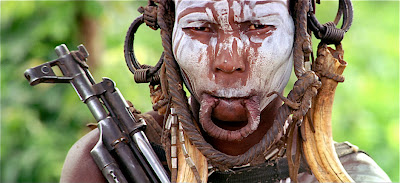
This year’s Jameson Dublin International Film Festival gave audiences the privilege of attending the European premiere of Ron Frike’s new film, Samsara (2011). As a fan of Frike’s work I had been eagerly awaiting the film’s release and, making the event all the more special was the fact that the film’s producer, Mark Magidson, was attending and providing a Q&A session after the screening.
I was lucky enough to see Frike’s previous film, Baraka (1992), a couple of years ago in the IFI, projected as it was intended from 70mm film. Like Baraka, Samsara is a non-verbal documentary. It does not follow a conventional plot but instead offers up a succession of powerful images, shot at diverse locations around the globe. Samsara was again shot using 65mm film stock and then transferred to digital for projection. The resulting film is a spectacular feast for the eyes, as the audience is transported to vistas few people are lucky enough to experience in person.
 The film opens to the hypnotic gaze of three Balinese dancers, and this first section of the film focuses mainly on ancient customs, religious and otherwise. There is an emphasis on the beauty of nature here but also on the destructive power it wields, as images of forests, littered with ancient temples, are juxtaposed with the ruins of a post-Katrina, New Orleans. In fact, the more tranquil moments of Samsara are continuously being interrupted by reminders of the fragility of civilization, such as volcanic eruptions, coupled with the remains of mummified bog-men and Egyptian Pharaohs. The tone during this first section of the film still retains a dislocated serenity though: a respectful admiration for mother-earth and the all-powerful passage of time.
As the film progresses, the focus shifts inwardly towards the urban and mankind’s questionable relationship with the environment. Time-lapse aerial views of bright city lights are contrasted with slum villages in the Philippines, while assembly lines give way to scenes from abattoirs and poultry processing plants. The slaughter of poultry and cattle are among the most distressing images in the film, as living creature is transformed into neatly packaged fast food item during the various stages of a production line. The film’s message here is quite heavy-handed in its denunciation of consumerism but perhaps this is the necessary approach in order to resonate with a society that is so often willing to turn a blind eye.
On a whole, Samsara, moves with a graceful rhythm, and at 99 minutes in length, without any dialogue, it manages to hold one’s attention throughout. This is aided by the film’s score, written by Marcello De Francisci, Michael Stearns and Lisa Gerrard (of Dead Can Dance). The soundtrack includes elements as diverse as the film’s images, ranging from Balinese Gamelan to upbeat techno, drawing the audience deep into the film’s flow.

As stated in the Q&A session afterwards, Ron Frike likes to think of his films as “guided meditations”, and this is definitely the effect that his films seem to have. Viewers are compelled to contemplate mankind’s place on the planet, and to look within themselves to question their own ethics and values. As one audience member remarked before asking her question, “I don’t think I’ll ever be able to eat meat again.” This is not to say that the film is pushing certain values, but rather that it offers the audience a chance to reflect on elements of our culture that are generally shied away from. The image of the sand mandala bookends the film and is key to the documentary’s message. As it is painstakingly created by a team of Tibetan monks and later destroyed with a few brushes of the hand, we are reminded of the impermanence of the world around us and that that we are merely guests on this earth that should take a step back to look at how we treat our environment during our stay here.